
· 123 ToDo Team · Tips & Tricks · 18 min read
Building Habits That Stick: Why You Give Up and How to Finally Break the Cycle
You start strong, then fade away. Sound familiar? Discover the science of habit formation and proven strategies to build routines that last - even with minimal time.
The Pattern You Know Too Well
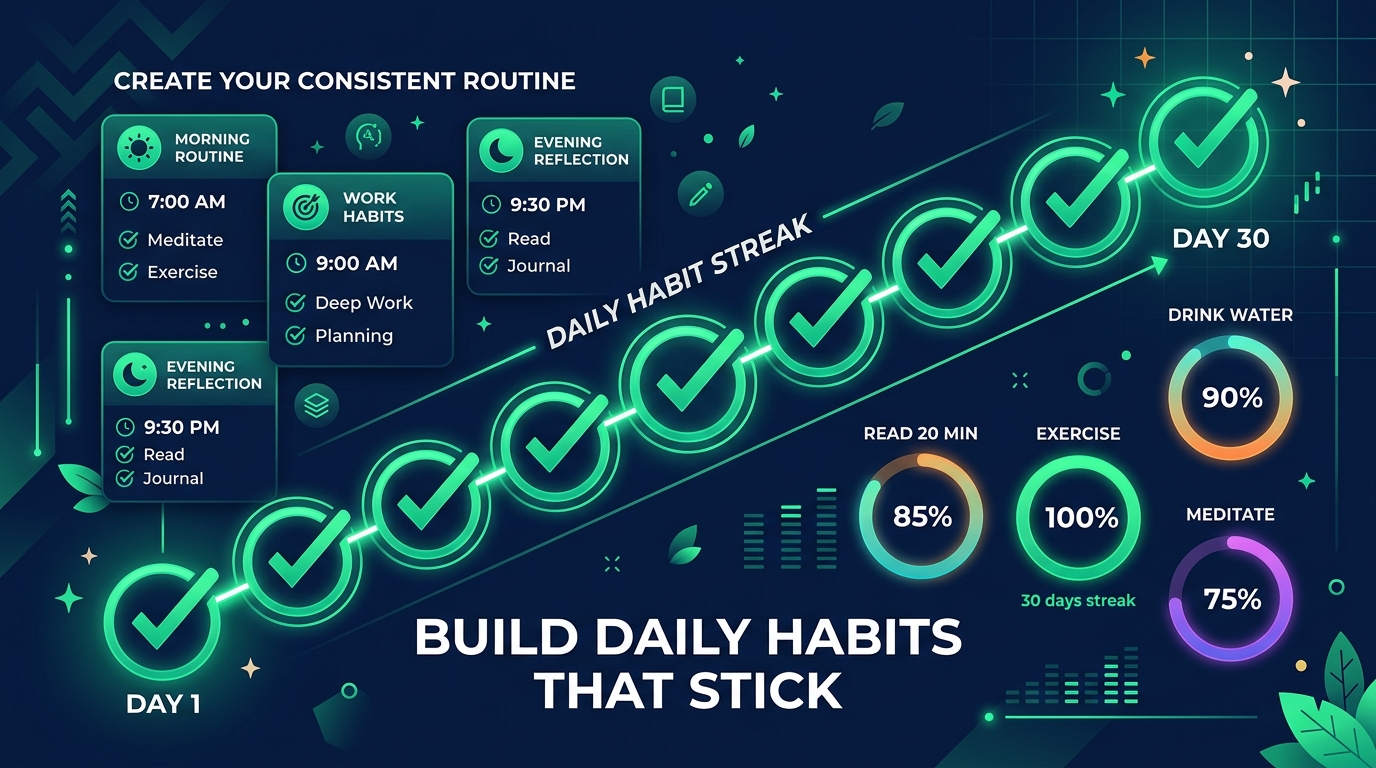
January 1st: “This is my year! I’m going to exercise daily, eat healthy, stay organized, learn a new language, and finally get my life together!”
January 15th: You’ve missed three workouts, organizational system abandoned, language app gathering digital dust.
February 1st: “Maybe next month…”
If this sounds painfully familiar, you’re not broken. You’re not lazy. You’re not lacking willpower.
You just haven’t been taught the real science of how habits actually form - and more importantly, how to make them stick when life gets messy, time gets scarce, and motivation disappears.
Let’s change that right now.
The Truth About Why You Give Up (It’s Not What You Think)
First, let’s destroy some myths that are sabotaging your success.
Myth #1: “It Takes 21 Days to Form a Habit”
The Reality: This popular myth comes from a 1960s book that misinterpreted research by plastic surgeon Maxwell Maltz. He noticed patients took about 21 days to adjust to facial changes. Somehow this became “any habit forms in 21 days.”
Actual research by Phillippa Lally at University College London found the real average is 66 days - and it ranges from 18 to 254 days depending on the habit complexity.
Why this matters: When your habit isn’t automatic by day 21, you think you’ve failed. You haven’t. You’re actually right on track. Most people quit just before the habit would have stuck.
Myth #2: “I Need Massive Motivation”
The Reality: Motivation is the worst foundation for lasting change.
Stanford behavior scientist BJ Fogg’s research proves that motivation is unreliable and fluctuates constantly. Basing habits on motivation is like building a house on quicksand.
What actually works? Tiny habits that require almost zero motivation. More on this in a moment.
Myth #3: “I Need More Willpower”
The Reality: Willpower is a finite resource that depletes throughout the day (called “ego depletion” in psychology research by Roy Baumeister).
Translation: By 3pm, your willpower tank is empty. This is why evening resolutions fail. Why you eat healthy at breakfast but binge at dinner. Why you plan to organize after work but collapse on the couch instead.
The solution isn’t more willpower - it’s systems that don’t require willpower.
Myth #4: “I Just Need to Try Harder”
The Reality: Effort isn’t your problem. Your approach is.
James Clear, author of Atomic Habits, explains: “You do not rise to the level of your goals. You fall to the level of your systems.”
Trying harder with a broken system just leads to burnout. What you need are better systems.
The Neuroscience of Why Habits Fail (And How to Fix It)
Let’s understand what’s happening in your brain when you try to build a new habit.
The Habit Loop
MIT neuroscientist Ann Graybiel discovered that habits are neurological loops with three components:
1. Cue: The trigger that initiates the behavior 2. Routine: The behavior itself 3. Reward: The benefit your brain associates with the behavior
When this loop repeats enough times, it becomes automatic - a neural pathway so strong it fires without conscious thought.
Here’s the problem: Most people focus only on the routine (the behavior) and ignore the cue and reward.
Example of why you fail:
- What you try: “I’m going to use my task manager every day!”
- What happens: You forget. There’s no cue triggering the behavior. No reward reinforcing it.
- Result: Within a week, abandoned.
Example of what actually works:
- Cue: “Right after I pour my morning coffee” (specific trigger)
- Routine: “I spend 2 minutes reviewing my tasks”
- Reward: “I feel prepared and in control for my day” (emotional benefit)
- Result: Habit sticks because all three elements are present.
The Goldilocks Rule of Habit Formation
Research by psychologist Mihaly Csikszentmihalyi on “flow states” reveals something crucial: habits stick best when they’re just challenging enough to be engaging, but not so hard they’re overwhelming.
Too easy = boring, no sense of achievement, habit fades Too hard = frustrating, depletes willpower, you quit Just right = engaging, achievable, sustainable
This is why “organize your entire life overnight” fails, but “write down 3 tasks each morning” succeeds.
The Aggregation of Marginal Gains
British Cycling’s performance director Dave Brailsford applied this principle to transform a mediocre team into Tour de France champions.
The concept: Improve by just 1% in multiple small areas, and the compound effect is remarkable.
Not 100% better at one thing. Just 1% better at 100 things.
Applied to habits: You don’t need to revolutionize your life. You need to improve tiny behaviors consistently.
- Writing down tasks: 1% better organization
- Prioritizing those tasks: 1% better focus
- Completing top priority first: 1% better execution
- Reviewing what worked: 1% better learning
After 30 days? You’re not 30% better. You’re exponentially better because improvements compound.
Real People Who Broke the “Give Up” Cycle
Let’s look at actual transformations - because sometimes you need to see it’s possible.
Michael’s Story: The Serial Starter
Background: 34-year-old software developer. Started and abandoned task management systems 11 times over 3 years. Tried apps, planners, bullet journals, complex productivity methods. Nothing stuck beyond 2 weeks.
The Problem: Michael always started with elaborate systems requiring 30+ minutes daily. High motivation on Day 1, but by Week 2, the time commitment felt like another task to manage.
The Breakthrough: Radically simplified. One commitment: “Add tomorrow’s top 3 tasks before bed. Takes 90 seconds.”
What Happened:
- Week 1: Built the tiny habit. 90 seconds, every night.
- Week 3: Started adding more tasks because it felt natural
- Week 5: Began prioritizing tasks with Must/Should/Could
- Month 3: System was automatic. Didn’t even think about it.
- Month 6: Promoted at work. Manager cited his “remarkable follow-through on priorities”
Michael’s insight: “I spent years trying to build the perfect system. Turns out I just needed the simplest system I’d actually use. Starting tiny was the difference.”
Time investment that worked: 90 seconds daily for 2 weeks, then gradually increased as habit solidified.
Rebecca’s Story: The Overwhelmed Parent
Background: 41-year-old mother of twin 6-year-olds, working full-time remotely. Constantly feeling behind. Tried multiple organizational systems but “never had time to keep up with them.”
The Problem: Rebecca believed she needed a comprehensive system to manage everything - kids’ schedules, work deadlines, household tasks, personal goals. Every system she tried required substantial daily maintenance she didn’t have time for.
The Breakthrough: Started with ONE category: Must Do Today. That’s it. Everything else was noise.
What Happened:
- Week 1: Each morning, identified 3 Must Dos (2 work, 1 personal/family)
- Week 2: Started completing those 3 tasks daily. First time in years everything critical got done
- Week 4: Added Should Do category for important-not-urgent items
- Month 2: Kids noticed “Mom seems less stressed”
- Month 4: Got positive performance review. Manager noticed improved deadline consistency
- Month 6: Lost 12 pounds (turns out managing tasks freed mental energy for health)
Rebecca’s insight: “I don’t have time for elaborate systems. But I do have time for 3 minutes each morning to identify what matters today. That tiny habit changed everything. I’m not more organized - I’m strategically organized.”
Time investment that worked: 3 minutes each morning. Focused only on what mattered most.
David’s Story: The Chronic Procrastinator
Background: 26-year-old graduate student. Self-described “professional procrastinator.” Would plan elaborate study schedules, then panic-work the night before deadlines. Pattern repeated for 8 years of higher education.
The Problem: David confused planning with action. He’d spend hours creating perfect study plans, color-coded schedules, detailed task breakdowns. The planning felt productive, so he’d reward himself with breaks. Then never execute the plan.
The Breakthrough: “No planning sessions over 5 minutes. Planning is not working. Only completing tasks counts.”
What Happened:
- Week 1: Forced himself to write down tasks in under 5 minutes, then immediately start working
- Week 2: Noticed he was actually completing more with less planning
- Week 3: Realized most detailed planning was procrastination disguised as productivity
- Month 2: Submitted first paper ahead of deadline in his academic career
- Month 4: Completed thesis chapter - something he’d been “planning to write” for 8 months
- Month 6: Defended dissertation. Graduated on time (was at risk of extension)
David’s insight: “I was addicted to the feeling of planning without the discomfort of doing. Setting a 5-minute limit on planning forced me to actually work. Turns out I wasn’t a procrastinator - I was a chronic over-planner avoiding real work.”
Time investment that worked: 5 minutes planning, then immediate execution. No more multi-hour planning sessions.
Lisa’s Story: The Busy Executive
Background: 52-year-old VP at tech company. “No time for task management systems” - relied on memory and email inbox as task list. Frequently missed commitments, felt constantly reactive.
The Problem: Lisa believed task management was for people with time to spare. She was too busy being busy to organize her busy-ness. Classic executive trap.
The Breakthrough: A mentor challenged her: “You have time to fix the problems caused by disorganization, but not time to prevent them?”
What Happened:
- Week 1: Started using 5 minutes during morning coffee to review priorities
- Week 2: Stopped missing meeting prep. Colleagues noticed she was “more prepared”
- Month 1: Delegated 3 recurring tasks she didn’t realize she was still doing
- Month 2: Found 6 hours per week of time wasted on non-priorities
- Month 4: Promoted to Senior VP. CEO cited “strategic focus and execution”
- Month 6: Left office by 5:30pm three days a week (unheard of previously)
Lisa’s insight: “I thought I was too busy to plan. Turns out I was too unorganized to be anything but busy. Five minutes of planning saves hours of reactive firefighting. Best ROI of any business practice I’ve implemented.”
Time investment that worked: 5 minutes each morning, 2 minutes before meetings. Found 6+ hours weekly as result.
The Science-Backed Framework That Actually Works
Now let’s build your unbreakable habit system using proven principles.
Step 1: Start Absurdly Small (The BJ Fogg Method)
Stanford’s BJ Fogg developed “Tiny Habits” based on this principle: Make the behavior so small it’s impossible to fail.
Not “organize my entire life” → “Write down 1 task” Not “use task manager daily for 30 minutes” → “Open task manager for 30 seconds” Not “complete all priorities” → “Complete 1 Must Do task”
Why this works: Zero barriers = zero excuses. You can’t talk yourself out of 30 seconds.
Your first habit (choose one):
- Each morning after coffee, open 123 ToDo and write down your #1 priority (30 seconds)
- Before bed, list tomorrow’s top 3 tasks (90 seconds)
- After lunch, check off completed tasks (15 seconds)
That’s it for Week 1. Just that one tiny habit.
Step 2: Anchor to Existing Habits (Implementation Intentions)
Peter Gollwitzer’s research shows that “if-then” plans (implementation intentions) double success rates for habit formation.
The formula: “After [existing habit], I will [new tiny habit]”
Examples:
- “After I pour my morning coffee, I will write down my top 3 tasks”
- “After I sit down at my desk, I will open 123 ToDo and check my Must Dos”
- “After I close my laptop for the day, I will review what I completed”
- “After I arrive home, I will add any personal tasks to tomorrow’s list”
Why this works: The existing habit becomes the cue in your habit loop. You’re not relying on motivation or memory - the trigger is automatic.
Step 3: Make It Obvious (Environmental Design)
Research by Wendy Wood shows that context and environment matter more than motivation for habit formation.
The principle: Remove friction from desired behaviors. Add friction to undesired ones.
For task management:
Make it obvious:
- Keep 123 ToDo on your phone’s home screen (not buried in a folder)
- If using desktop, bookmark directly to app
- Set a daily reminder at your anchor time
- Write “Check tasks” on a post-it at your desk
Remove friction:
- One tap to open = easy
- Simple interface = no decision fatigue
- Works offline = no barriers
- No login required = immediate access
Compare to complex systems:
- Multiple taps to find app = friction
- Complicated interface = decision fatigue
- Requires internet = barrier when offline
- Login required = obstacle every time
The easier the behavior, the more likely it becomes automatic.
Step 4: Build the Reward Loop (Immediate Gratification)
Charles Duhigg’s research in “The Power of Habit” emphasizes: Habits stick when the reward is immediate and satisfying.
The challenge: Most productivity benefits are delayed. Completing tasks today helps tomorrow’s you, but your brain wants rewards NOW.
The solution: Create immediate micro-rewards.
In 123 ToDo:
- Checking off a task = visual satisfaction + dopamine hit
- Seeing empty Must Do list = sense of accomplishment
- Milestone celebrations (5, 10, 15 tasks) = gamified rewards
- Watching task counter decrease = progress visualization
Add your own rewards:
- Tiny celebration (fist pump, “yes!”, smile)
- Physical check mark on paper list (satisfying)
- Tell someone “Crossed off my top priority!”
- Two minutes of guilt-free phone browsing after completing Must Dos
Why this works: Your brain learns “completing tasks = feel good” and starts craving the behavior.
Step 5: Plan for Failure (Resilience Building)
Research by Heidi Grant Halvorson shows that planning for obstacles increases success rates by 300%.
Most people: “I’ll do this every day!” → One missed day → “I’ve failed” → Give up
Successful people: “When I miss a day, I’ll restart immediately without guilt”
Implementation:
When you miss a day:
- Don’t spiral into guilt (waste of energy)
- Don’t “make up for it” with extra tasks (overwhelm)
- Simply restart the next day
- One missed day does NOT erase progress
When motivation drops:
- Return to your tiny habit (the bare minimum version)
- Complete just that one small action
- Usually you’ll do more, but minimum is okay
- Consistency > intensity
When life gets chaotic:
- Reduce to absolute minimum (e.g., just Must Dos)
- Lower the bar temporarily (1 task instead of 3)
- Maintain the habit, even in smallest form
- Rebuild when life calms down
The mantra: “Never miss twice in a row. Two days breaks a habit. One day is just life.”
The Realistic Timeline for Lasting Change
Let’s set accurate expectations based on actual research.
Week 1-2: The Honeymoon (Easy But Fragile)
What’s happening: New behavior feels novel and exciting. Motivation is high. You’re optimistic.
The trap: This feels easy, so you add complexity. Big mistake. The ease is temporary.
Your job: Build the tiny habit exactly as designed. Resist the urge to do more. Nail the minimum.
Success marker: You’ve done the tiny habit 10+ days in a row.
Week 3-4: The Dip (When Most People Quit)
What’s happening: Novelty wears off. Motivation drops. Life gets busy. The behavior isn’t automatic yet.
The trap: “This isn’t working anymore. Maybe I need a different system.” (This is exactly when it’s starting to work.)
Your job: Push through. This is the critical moment. The behavior is becoming neurological. Your brain is literally rewiring.
Success marker: You’ve continued the habit even when you didn’t feel motivated.
Week 5-8: The Build (Progress Becomes Visible)
What’s happening: Habit feels easier. You start doing it without much thought. Missing it feels odd.
The opportunity: Gradually increase complexity. Add one small element to your system.
Your job: Reinforce the core habit while carefully expanding.
Success marker: The behavior feels more automatic than forced.
Week 9-12: The Foundation (Habit Solidifies)
What’s happening: Neural pathways are forming strongly. The habit is becoming part of your identity.
The opportunity: Build additional related habits using the same system.
Your job: Continue consistency. The habit is strong but not yet permanent.
Success marker: You do it without thinking. Missing it feels wrong.
Month 4-6: The Automation (Habit Becomes Identity)
What’s happening: Behavior is automatic. It’s not “something you do” - it’s “who you are.”
The transformation: You don’t “use a task manager.” You’re “an organized person.”
Your job: Maintain and optimize. This is your new normal.
Success marker: People comment on your consistency. You can’t imagine not doing this.
Building Routines When You Have “No Time”
The #1 excuse for not building habits: “I don’t have time.”
The truth: You have time. You’re allocating it elsewhere.
Let’s prove it.
The Time Audit Reality Check
Research by the Bureau of Labor Statistics shows average American daily time allocation:
- Social media: 2 hours 25 minutes
- TV/streaming: 3 hours 10 minutes
- Total leisure/screen time: 5+ hours
You don’t lack time. You lack prioritization of time.
The question isn’t “Do I have time?” It’s “Is this important enough to prioritize?”
The Micro-Habit Solution for Busy People
If you genuinely only have 2-5 minutes daily, that’s enough. Here’s proof:
2 minutes daily for task management:
- Day 1-30: Write down top 3 priorities (2 min/day = 60 minutes total)
- Result: 90+ tasks completed that would have been forgotten or delayed
Time ROI: Invested 60 minutes. Prevented hours of scrambling, missed deadlines, and mental overwhelm.
5 minutes daily for task management:
- Morning: Review and prioritize (3 min)
- Evening: Update and plan tomorrow (2 min)
- Result: Consistent execution on important work. Reduced stress. Better sleep.
Time ROI: Invested 2.5 hours monthly. Saved countless hours of firefighting, reactive work, and stress recovery.
The “Found Time” Strategy
Most people don’t need NEW time. They need to redirect existing time.
Dead time you can reclaim:
- Waiting for coffee to brew (2 minutes) → Review tasks
- Commute on train/bus (5 minutes) → Plan priorities
- Before meeting starts (3 minutes) → Check off completed tasks
- Lunch break start (2 minutes) → Mid-day review
- Before bed (90 seconds) → Tomorrow’s top 3
None of this requires carving out new time. It’s redirecting time you’re already spending.
The Compound Effect: Small Habits, Big Results
James Clear’s research shows that habits compound exponentially over time.
1% improvement daily = 37x better after one year (1.01^365 = 37.78)
Let’s apply this to task management:
Month 1: Foundation
- Habit: Write down tasks daily (2 min/day)
- Direct result: 60+ tasks captured instead of forgotten
- Indirect result: Reduced mental clutter, better sleep
Month 2: Expansion
- Habit: Prioritize tasks daily (add 1 min/day)
- Direct result: Focus on what matters
- Indirect result: Important projects progressing
Month 3: Optimization
- Habit: Review weekly progress (add 5 min/week)
- Direct result: Pattern recognition, improved planning
- Indirect result: Strategic thinking improving
Month 6: Transformation
- Cumulative habits: 5-7 min daily
- Direct result: Consistent execution on priorities
- Indirect result: Promotion, project success, career advancement
Year 1: Identity Shift
- You’re no longer “trying to be organized”
- You ARE an organized person
- This is simply how you operate
Total time invested in Year 1: ~30 hours (about 4 full work days)
Total impact: Career advancement, stress reduction, consistent achievement, better relationships (less stress = better partner/parent/friend)
ROI: Incalculable
Your Unbreakable Habit-Building Plan
Ready to be the person who sticks with it? Here’s your proven system.
Week 1: The Foundation Habit
Your commitment: Write down 3 tasks every morning after [your existing habit]
Rules:
- Must be after an existing habit (coffee, shower, desk sitting, etc.)
- Must take under 2 minutes
- Quality doesn’t matter - just do it
- Missing one day is okay - just don’t miss two
Success metric: 5+ days completed
Week 2: The Consistency Proof
Your commitment: Same as Week 1, but now add a tiny reward
The reward: After writing tasks, say “Done!” and physically check it off a tracking sheet
Why: Reward reinforces behavior
Success metric: 10+ days total completed
Week 3-4: The Dip Survival
Your commitment: Same habit + planning for obstacles
Prepare for:
- Busy day → Still write 3 tasks (even if shorter)
- Forgot morning → Do it at lunch
- Traveling → Use phone instead of computer
- Unmotivated → Do it anyway, even poorly
Success metric: Continued through at least one difficult day
Week 5-8: The Natural Expansion
Your commitment: Core habit + one small addition
Choose ONE addition:
- Start prioritizing tasks (Must/Should/Could)
- Complete top task before checking email
- Review completed tasks at day end
Rules: Only add ONE thing. Master it before adding more.
Success metric: Both habits feel natural
Week 9-12: The Identity Formation
Your commitment: Full system running consistently
What you’re doing now:
- Morning: Quick task review and prioritization (3 min)
- During day: Complete Must Dos first
- Evening: Brief review of what got done (1 min)
Success metric: It feels weird NOT to do this
Beyond Month 3: The Compound Returns
Your job: Maintain consistency while life improves around you
What you’ll notice:
- Projects completing
- Deadlines met comfortably
- Stress reducing
- Others commenting on your reliability
- Opportunities appearing (organized people get promoted)
The Ultimate Truth About Sticking With It
Here’s what nobody tells you about building lasting habits:
It’s not about motivation. It’s not about discipline. It’s not about willpower.
It’s about designing systems so good that you’d have to actively fight against them to fail.
When you:
- Start tiny (impossible to fail)
- Anchor to existing habits (automatic trigger)
- Remove all friction (effortless to do)
- Build in immediate rewards (satisfying)
- Plan for obstacles (resilient)
Failure becomes harder than success.
That’s the secret. Make the right behavior the easy behavior.
Your Moment of Decision
You’re at a crossroads right now.
Path 1: Close this article. Think “that was interesting.” Do nothing. Six months from now, wonder why nothing changed.
Path 2: Choose ONE tiny habit from this article. Do it tomorrow. Then the next day. Then the next.
Six months from Path 2? You’re the person who sticks with things. Who follows through. Who achieves goals. Who others ask “How do you stay so organized?”
The difference between these paths is one decision.
Not a big decision. Not a life-overhaul decision.
Just: “Tomorrow morning after [existing habit], I will [tiny new habit] for [specific tiny time].”
That’s it. One sentence. One commitment.
Will you make it?
Start Your Stick-With-It Journey
Open 123 ToDo and write down ONE task →
Not three tasks. Not ten tasks. ONE task.
Then complete it. Check it off. Feel the small victory.
That’s Day 1 of your new habit.
Tomorrow? Same thing. One task.
By Week 2? You’ll probably be managing multiple tasks without thinking about it.
By Month 3? This will be automatic.
By Month 6? You’ll be the person who sticks with things.
The journey starts with one task. Today.
Your Tiny Habit Commitment
Fill this in right now (seriously, write it down):
“After I [existing habit], I will [new tiny habit] for [specific time].”
Example: “After I pour my morning coffee, I will open 123 ToDo and write down my top priority for 60 seconds.”
Your commitment:
After I ****_****, I will ****_**** for ****_****.
Start date: Tomorrow (don’t wait - tomorrow is your Day 1)
Accountability: Tell one person about your tiny habit
Reminder: Set a phone reminder for your trigger time
Welcome to the community of people who stick with it. We believe in you. 🎯
Need support on your habit-building journey? Struggling with consistency? Want to share your wins? Email us at support@123todo.com - we’re here to help you succeed.